
Building a website that generates steady income through Google AdSense is one of the most popular and realistic ways to make money online. Unlike short-term hustles, a well-built AdSense website can earn passively for years when done correctly. However, success does not come from luck or shortcuts. It requires strategy, patience, and a solid understanding of how content, traffic, and advertising work together.
This guide walks you through the entire process of building a money-making website with Google AdSense, from choosing the right niche to optimizing earnings. It is written for beginners but goes deep enough to help intermediate users improve results.
How Google AdSense Works
Google AdSense is an advertising program that allows website owners to earn money by displaying ads on their sites. Advertisers pay Google to show ads, and Google shares a portion of that revenue with publishers when visitors view or click those ads.
AdSense earnings depend on several factors:
- The number of visitors your website receives
- The type of ads displayed
- The value advertisers place on your niche
- Visitor location and behavior
You do not control the exact ads shown, but you influence earnings through content quality, traffic sources, and site structure.
Step 1: Choosing the Right Niche
Choosing the right niche is the foundation of a successful AdSense website. A niche determines your audience, content direction, and earning potential.
What Makes a Good AdSense Niche?
A profitable AdSense niche usually has three qualities:
- High advertiser demand – Businesses are actively paying to advertise
- Consistent search traffic – People regularly search for related topics
- Low to moderate competition – You can realistically rank in search engines
Examples of strong AdSense niches include personal finance, insurance, health, technology, education, home improvement, and online tools. However, sub-niches often perform better than broad topics.
Instead of targeting “fitness,” for example, a narrower focus like “home workouts for busy professionals” is easier to grow and monetize.
Read Also: All You Need To Know About Common Flowers
Step 2: Registering a Domain and Hosting
Once your niche is clear, the next step is setting up your website’s foundation.
Choosing a Domain Name
A good domain name should be:
- Easy to remember
- Simple to spell
- Relevant to your niche
- Preferably a .com extension
Avoid long or confusing names. Branding matters, even for content-focused websites.
Selecting Reliable Hosting
Your hosting provider affects website speed, uptime, and user experience. Slow or unstable sites struggle with traffic and AdSense approval.
Choose hosting that offers:
- Good loading speed
- High uptime
- Easy WordPress installation
- Responsive customer support
Shared hosting is fine for beginners, and you can upgrade as traffic grows.
Step 3: Setting Up WordPress Correctly
WordPress is the most popular platform for AdSense websites due to its flexibility and ease of use.
After installing WordPress:
- Choose a clean, responsive theme
- Avoid cluttered designs
- Prioritize readability and navigation
Your theme should look professional on both desktop and mobile devices. Google values user experience, and visitors stay longer on clean, fast-loading sites.
Step 4: Creating High-Quality Content That Ranks
Content is the most important factor in building a money-making AdSense website. Without quality content, traffic and earnings will not come.
What Type of Content Works Best for AdSense?
Informational content performs best. This includes:
- How-to guides
- Tutorials
- Explanations of concepts
- Comparisons and reviews
- Problem-solving articles
These types of content attract organic search traffic and keep visitors engaged, which increases ad impressions.
Writing Content That Google Loves
Each article should:
- Solve a real problem
- Be well-structured with headings
- Provide clear explanations
- Avoid keyword stuffing
- Offer original insights
Aim for depth rather than volume. One well-written article can outperform ten shallow ones.
Step 5: Understanding SEO for AdSense Websites
Search engine optimization (SEO) is how people find your website. Without SEO, even great content may remain invisible.
Keyword Research Basics
Keyword research helps you understand what people are searching for. Focus on:
- Long-tail keywords (more specific phrases)
- Low competition terms
- Search intent aligned with information
For example, “how to fix slow Wi-Fi at home” is more targeted than “Wi-Fi problems.”
On-Page SEO Essentials
Each article should include:
- A clear title
- Proper heading structure
- Natural keyword usage
- Internal links to related content
- Fast-loading images
SEO is not about tricking search engines. It is about making your content easier to understand and discover.
Step 6: Applying for Google AdSense Approval
Before earning, your website must be approved by Google AdSense.
What Google Looks For
Google reviews websites to ensure they meet quality standards. Your site should have:
- Original, valuable content
- Clear navigation
- A professional appearance
- Privacy policy and contact page
- No prohibited content
It is recommended to publish at least 15–20 high-quality articles before applying.
Common Reasons for Rejection
Many websites are rejected because of:
- Thin or copied content
- Poor design
- Lack of essential pages
- Policy violations
If rejected, you can fix issues and reapply.
Step 7: Placing Ads for Maximum Earnings
Once approved, proper ad placement significantly affects revenue.
Where Ads Perform Best
High-performing ad locations include:
- Within content (after first few paragraphs)
- In the middle of articles
- At the end of content
- Sticky sidebar ads on desktop
Avoid placing too many ads. Overloading pages reduces user experience and can lower earnings over time.
Step 8: Increasing Traffic to Boost AdSense Income
More quality traffic usually means higher earnings, but traffic must be targeted.
Best Traffic Sources for AdSense
Organic search traffic is the most valuable because users arrive with intent. Other useful sources include:
- Pinterest for visual niches
- Quora and forums for authority building
- Email newsletters for returning visitors
Avoid paid traffic schemes or artificial traffic sources, as they violate AdSense policies.
Step 9: Optimizing AdSense Earnings Over Time
Earning with AdSense improves as your site matures.
Key Metrics to Monitor
Understanding these metrics helps you grow income:
- CTR (Click-Through Rate) – Percentage of users clicking ads
- CPC (Cost Per Click) – How much each click earns
- RPM (Revenue Per Thousand Views) – Overall earning efficiency
Improving content quality, visitor engagement, and ad placement can gradually increase these numbers.
Common Mistakes to Avoid
Many beginners fail because of avoidable mistakes:
- Expecting fast money
- Publishing low-quality content
- Ignoring SEO
- Clicking their own ads
- Violating AdSense policies
AdSense rewards consistency and patience, not shortcuts.
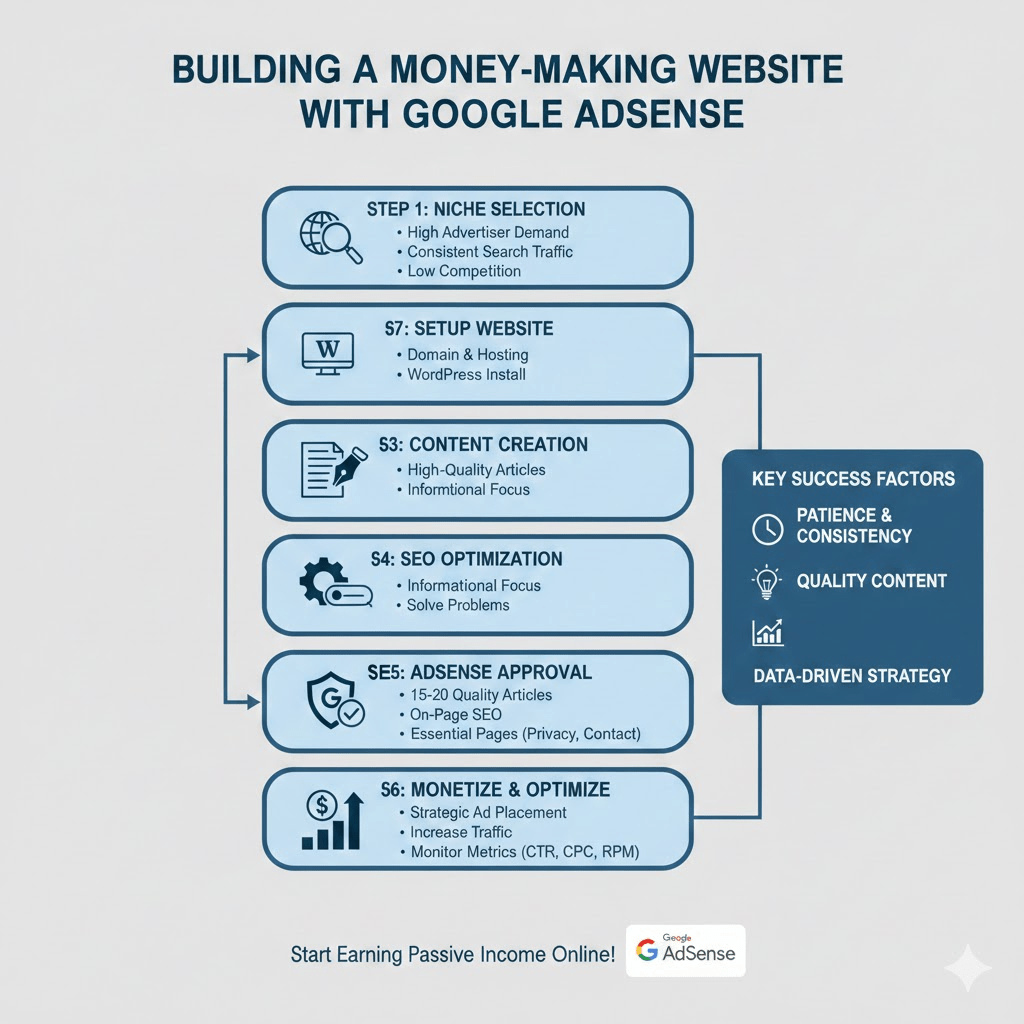
Building an AdSense Website
| Stage | Purpose | Key Focus |
|---|---|---|
| Niche Selection | Profit potential | Demand and competition |
| Website Setup | Foundation | Speed and usability |
| Content Creation | Traffic growth | Value and depth |
| SEO | Visibility | Search intent |
| Ad Placement | Revenue | User experience |
| Optimization | Scaling income | Data-driven improvements |
Frequently Asked Questions
1. How long does it take to make money with Google AdSense?
Most websites take three to six months to start earning, depending on content quality, competition, and SEO effort. Significant income often takes a year or more of consistent work.
2. How much can a beginner realistically earn?
Beginners may earn small amounts initially, often a few dollars per month. As traffic grows, earnings can increase to hundreds or even thousands monthly for successful sites.
3. Is Google AdSense still worth it today?
Yes, AdSense remains relevant, especially for informational websites. While competition has increased, quality content and proper SEO still perform well.
4. Can I run AdSense on multiple websites?
Yes, you can use one AdSense account across multiple approved websites, provided all sites follow Google policies.
5. What happens if my AdSense account gets banned?
If your account is banned, earnings are usually forfeited. This is why following policies strictly and avoiding risky behavior is critical.
Building a money-making website with Google AdSense is not a get-rich-quick scheme, but it is one of the most reliable long-term online income strategies. Success comes from choosing the right niche, creating genuinely helpful content, mastering SEO fundamentals, and maintaining patience.
When treated as a real project rather than a shortcut, an AdSense website can grow into a valuable digital asset that generates income long after the work is done.
Do you have any questions, suggestions, or contributions? If so, please feel free to use the comment box below to share your thoughts. We also encourage you to kindly share this information with others who might benefit from it. Since we can’t reach everyone at once, we truly appreciate your help in spreading the word. Thank you very much for your support and for sharing!
Read Alo: How to Choose the Right Mason Jar Decor for Your Home